
Start with the door swing, where you stand to reach into the cabinet and what sits alongside it. Those details help narrow the hinge options.
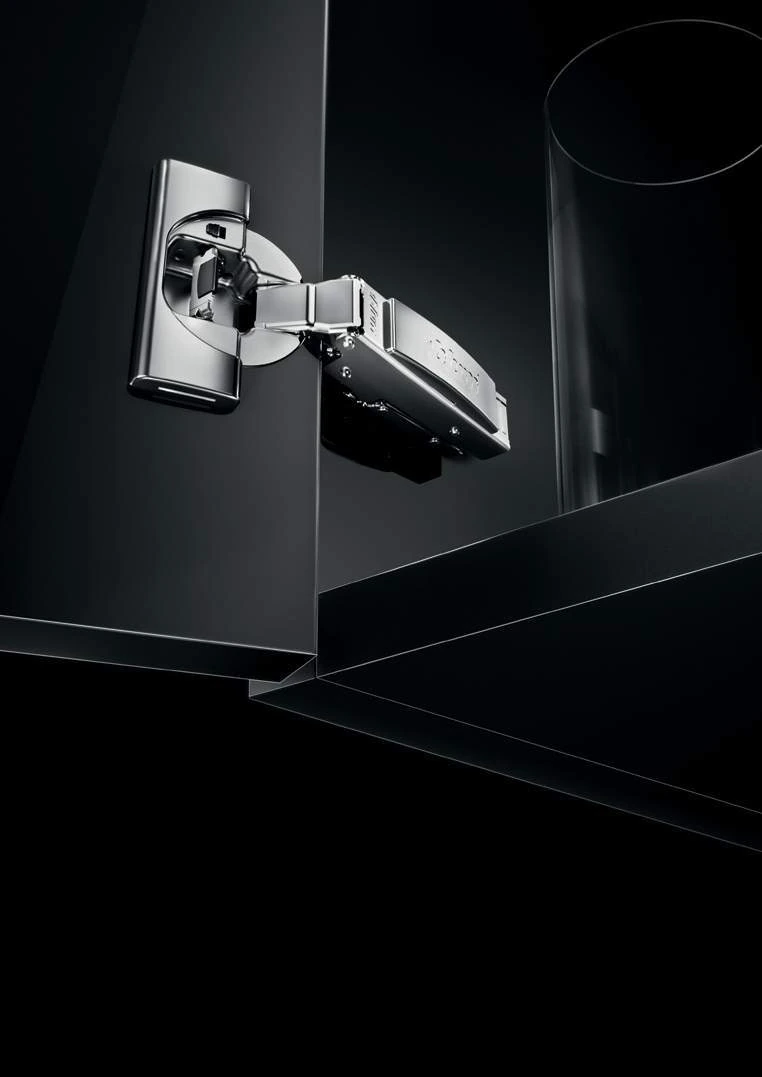
Image from Blum’s CLIP top BLUMOTION 107° product brochure, PDF p. 1. It shows the 107° variant. The hinge model is selected for the door and cabinet.
What the integrated damper does
Blum builds the BLUMOTION damper into the hinge cup. It slows the door as it reaches the end of its closing travel. That can be useful on cabinet doors you open often, such as the ones near the dining table or crockery storage. Blum also describes deactivating the soft-close function where appropriate for a small or light door. Check the guidance for the selected model and try it on the actual front. When a cabinet run has doors of different weights, try the closing action of each door individually.
Consider thickness, overlay and corners together
The range includes different opening angles and mounting configurations. Measure the door thickness and establish whether it overlays the cabinet side, shares a side panel with a neighbouring door or fits inside the opening. Draw the swing to check for contact with handles, walls and appliances. If the cabinet has an internal drawer or basket, check that you can pull it out fully with the door open. Include the handle projection in the swing check, especially beside a tall cabinet or fridge.
Try the door in its intended position
Test the door and mounting plate together, starting with even gaps and a comfortable reach. Close the door with a gentle push and see how it approaches the cabinet. Where two doors are close, try opening them one at a time and together. Record the opening angle, overlay arrangement and matching plate in the project specification. At handover, ask how to realign the cabinet fronts if they need adjustment later.
Product references
Blum 百隆《CLIP top BLUMOTION 107°》产品册 PDF 第 1 页
Blum 百隆《V1 套装信息及订购手册 2024–2025》第 30–33 页